So many of us found ourselves asking the same question through the upheaval of COVID-19: How can I help? Health workers from all over the world were fighting to secure the equipment and support they needed to keep going. Students, volunteers, and the public at-large kept asking how they could help with the skills they had, even though they were not in healthcare. We believe there is room for anyone to jump and help out, and we create those avenues.
We serve as thinkers, translators, and pathfinders, able to see a problem from source to bedside, to move between contexts, and to bring the local and the global into the same room.
Project Prana Foundation exists to make sure the people closest to a problem are also the people best positioned to solve it. We work to remove the friction between an idea and the systems that could carry it forward, so good ideas do not stop at the edge of a single project, hospital, or classroom.
We are not built to run one program. We are built to build the ecosystems that make many programs possible, and to keep them going long after the first spark of interest fades.
Mission
To build the infrastructure, information, and relationships that let healthcare innovation move, from the person who sees the problem to the system that can scale the solution.
Vision
A world where healthcare innovation is continuous, connected, and locally owned, where solving hard problems is possible, everywhere.
Many good healthcare ideas don't fail. They stop.
A student graduates. A grant ends. A team disbands. The work starts over somewhere else, from nothing. Project Prana exists so it doesn't have to.
A cross-section our ecosystem
We don't run six separate programs. We build one ecosystem, layers of infrastructure that hold problems, people, projects, and knowledge together.
Layer 06 · Into the worldImplementation + Learning+
Ideas are tested where care actually happens, and what we learn is fed back into the ecosystem for the next team.
Results return downward as knowledge, closing the loop back to real needs.
Layer 05 · Keeping work aliveContinuity Infrastructure / Idea NurseryComing soon+
A way to give promising ideas the support and continuity they need to grow, so when a team graduates, the project doesn't disappear with them.
Projects are held, handed over, and carried forward instead of starting over.
Layer 04 · InstitutionsUniversity Hubs+
A way to spur multi-site, multi-year innovation in any institution, so work is anchored in places that outlast any single cohort.
Projects and people connect across campuses; relationships form between institutions.
Layer 03 · Young innovatorsSHINE+
A way to nurture young innovators by giving them problems even adults haven't solved yet, and the mentorship to take them seriously.
Students meet documented problems and begin forming early projects.
Layer 02 · The foundation of skillLearning Infrastructure+
Practical innovation and research learning, made accessible, so anyone who wants to help can build the skills to do it well.
Knowledge flows upward; people enter and gain the tools to engage with real needs.
Layer 01 · The groundReal Needs + Problem IntelligenceComing soon+
Everything starts with real healthcare problems, gathered from clinicians, patients, and communities, then documented so they can be understood, not guessed at.
Problems enter the ecosystem here and rise toward the people who can work on them.
- Innovation OS, shared infrastructure that runs through every layer.
Our History
From an emergency response effort to a foundation building the systems healthcare innovation needs to keep going.
Read about our deviceIn the early days of the pandemic, the need was simple and urgent: get protective equipment and oxygen to the people who needed it. A small group of clinicians, engineers, students, and researchers began coordinating across time zones to source, verify, and deliver supplies, and to answer questions no one had answered yet.
What we saw in that work was a collaboration model that could outlast the emergency. The hardest problems in healthcare are rarely technical alone; they are problems of continuity, coordination, and access. So we kept the network and changed the mission.
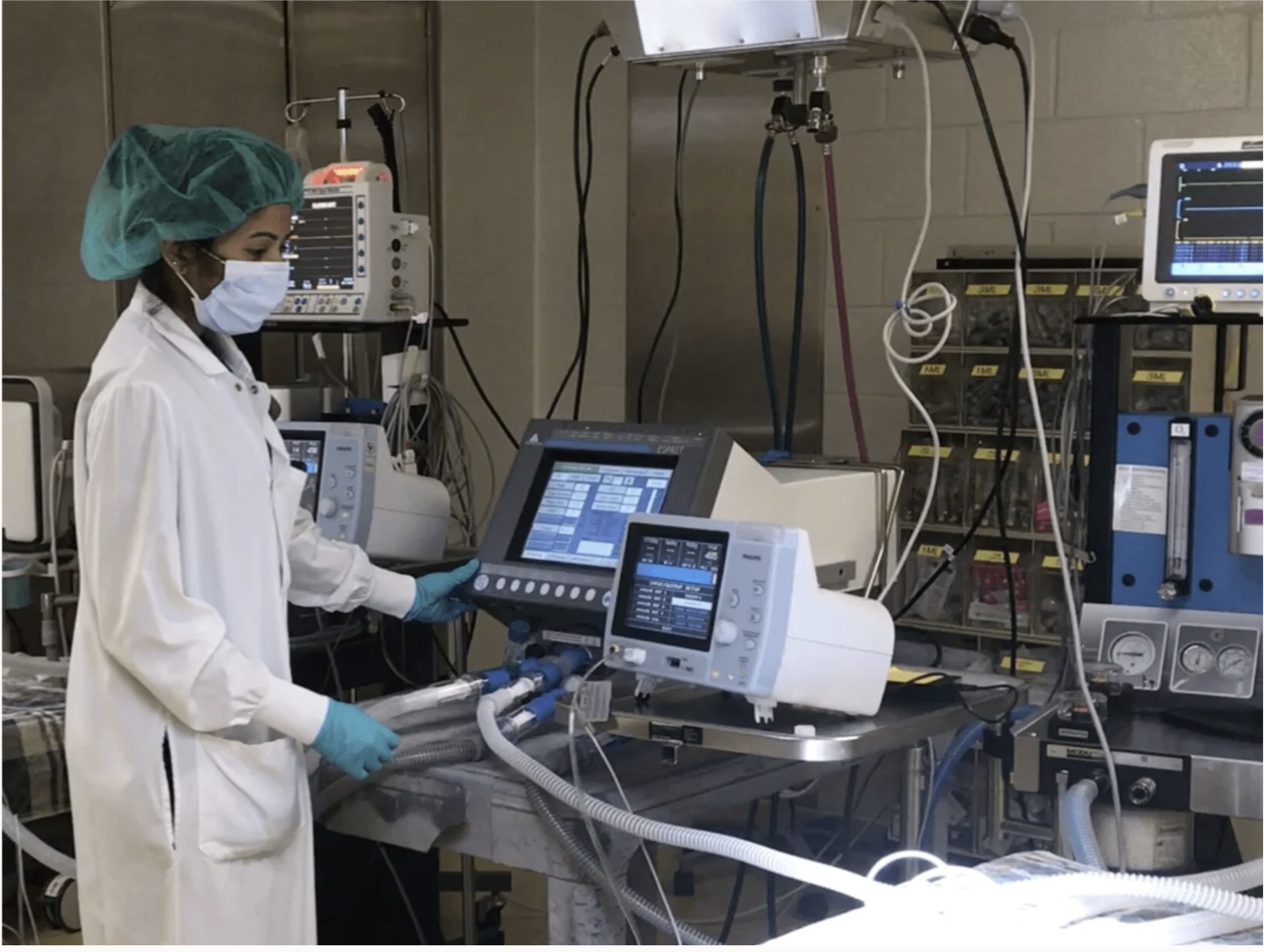
The foundation was guided by the voluntary leadership and support of clinicians, faculty, and students across institutions, people who gave their time, expertise, and networks to keep the work moving.
Today, that same spirit shapes every program: real problems, real mentorship, and pathways that let promising work continue past a single semester, grant cycle, or hospital.
We continue to invest in digital tools, training, and partnerships so that innovators anywhere can learn, build, test, and scale healthcare solutions without waiting for permission. The people closest to the problem should have what they need to solve it.